
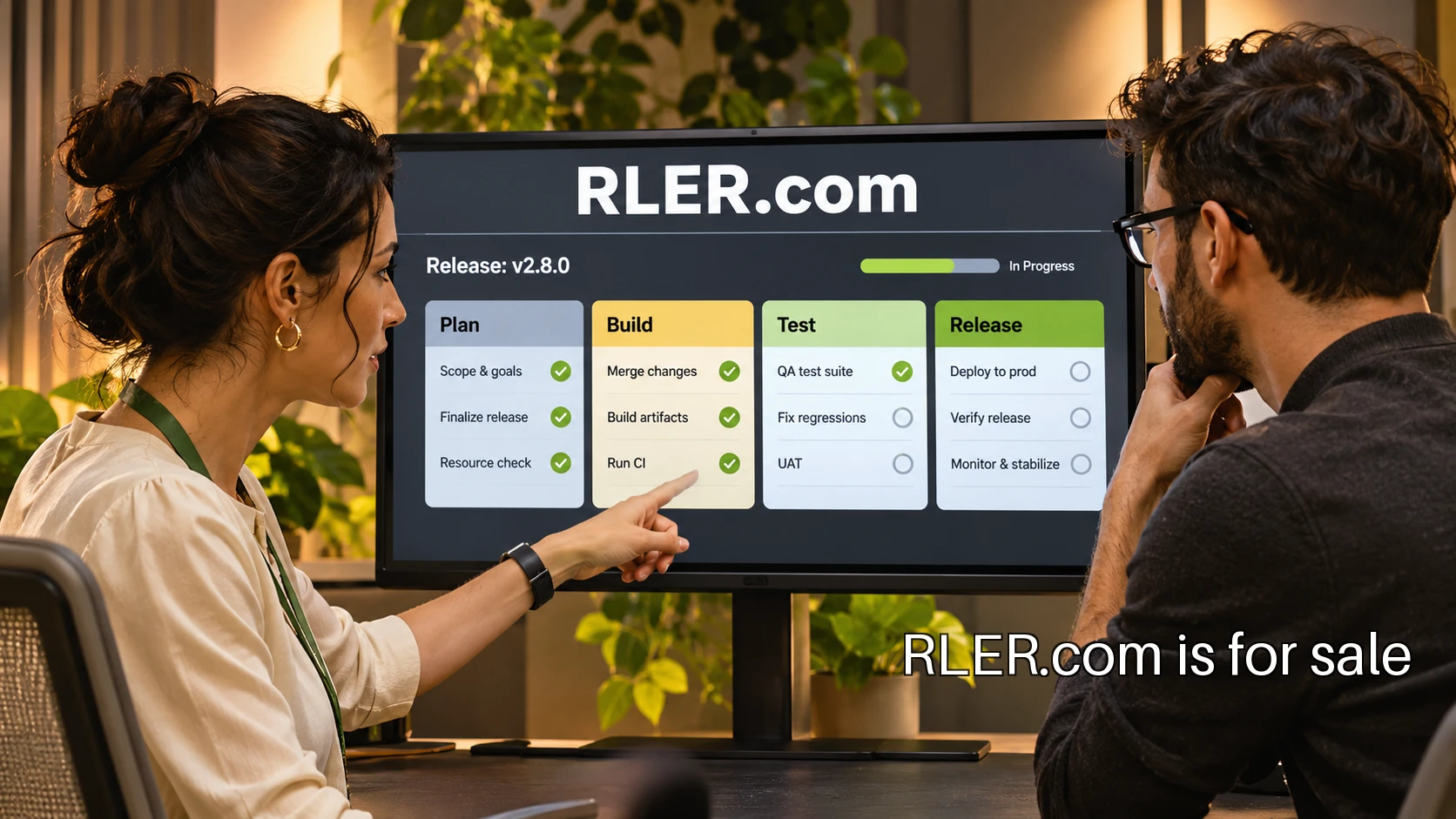
The moment a release crosses teams
A small software release can be technically ready while the customer announcement, support notes and final approval live in different places. A release coordination workspace would bring those handoffs into one record. The first buyer could be a product lead in a small software team who currently asks several people for the same update before every launch. Under RLER, the founder could build one release workspace with a clear identity on the plan and the handoff.
This is an illustrative business concept, not an operating product. The first offer would be deliberately small: one shared release record, linked evidence and an explicit decision about readiness. Engineering would keep its existing issue tracker. Customer teams would keep their communication tools. The workspace would hold the agreement connecting them, so a release owner could see the current state without translating a conversation into another spreadsheet.
Make one release record useful
Imagine a team preparing a new account invitation flow. The release record starts with the change in plain language, the intended release window and one accountable owner. It links the implementation review, the test evidence, the help article and the customer notice. Each linked item has a person responsible for saying it is ready. The record ends with a visible release decision and a place to record what happened afterward.
The important design choice is the distinction between a linked task and a required decision. A task can be complete while a decision is still unresolved. The engineer may finish the invitation screen while the product lead is still choosing how existing accounts should be handled. A useful record would keep that question visible instead of converting every uncertainty into a green completion marker. The founder could demonstrate the difference with one realistic release before writing a broader roadmap.
Fit around the team's current tools
GitHub's Projects documentation describes issue-linked tables, boards and custom fields. That is useful reference material for designing a release record, rather than a reason to rebuild an issue tracker. The proposed product would concentrate on the handoff between groups: which evidence supports the release, which decision is open, and who can close it.
A first prototype could accept links manually. Automatic synchronization would wait until interviews show which updates genuinely need it. Start with a readable release page, a change history and notifications tied to an explicit action. If every edited sentence produces another alert, the coordination tool becomes one more channel to mute. The product should make it possible to subscribe to a release decision without receiving every background change.
Find the first teams through a release review
One credible distribution path is a short, practical review of a team's last release. Ask the product lead to reconstruct the sequence from code ready to customer informed. Invite the support lead to identify the questions that reached them late. Then show the release record using that team's own public or sanitized example. The conversation starts with a recognisable coordination problem and ends with a prototype the team can judge.
The initial offer might cover a small number of active releases and collaborators, with pricing developed through direct buyer conversations. The product needs permission boundaries, reliable activity history and a way to export a finished record. A customer should be able to leave with the release evidence intact. Those details are part of the first useful offer because a coordination record becomes less valuable when the team cannot retrieve it later.
Test the exceptions before adding automation
A release may be paused, split into stages or reversed. The record needs a clear way to show each outcome. Work through a feature that ships to internal users first, then a small external group, then everyone. Decide which stage creates a customer notice and which person owns the change in status. A single ready button will be too vague if those steps carry different consequences for the team.
Accessibility belongs in that early prototype. W3C's forms tutorial explains labels, grouped controls and useful notifications. Apply those principles to approval controls so the person confirming a release can understand the action with a keyboard or assistive technology. A status color can reinforce a written state, but the written state should carry the meaning.
Sketch the first handoff
Before building integrations, map one release from its initial plan to the final customer message. Write down the owner, the evidence and the open decisions at each step. Then remove fields nobody used to make a decision. The result is a stronger first product brief than a list of every project management feature a team might request.
RLER fits this concept as a compact identity that can sit across the release record, notifications and shared workspace. A founder could start with the coordination problem and carry the name into related release work as the product develops. To discuss acquiring RLER.com for that direction, send a price inquiry with the intended product and the acquisition approach in mind.